
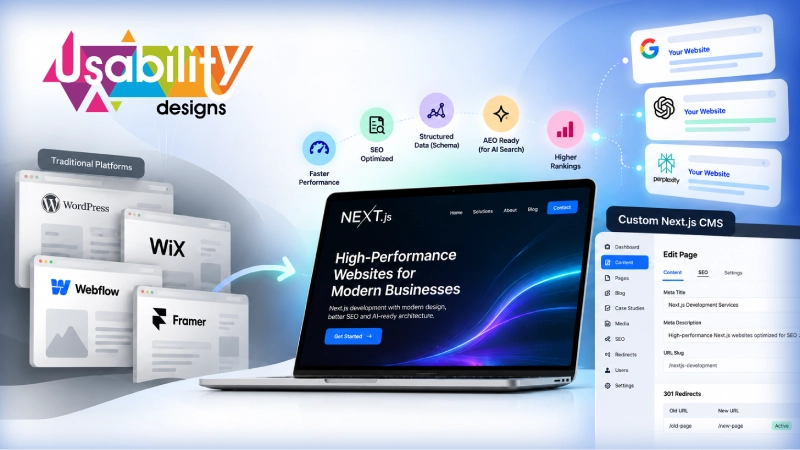
Search engines are evolving, and AI-powered platforms like ChatGPT, Google AI Overviews, and Perplexity are changing how users discover information. Businesses need websites that are fast, technically optimized, and structured to help search engines and AI systems understand their content. Next.js website development offers a powerful foundation for improving Search Engine Optimization (SEO) and Answer Engine Optimization (AEO).
At Usability Designs , we help businesses modernize their digital presence by migrating from traditional platforms like WordPress, Wix, Webflow, and Framer to high-performance Next.js websites.
How Next.js Improves SEO and AEO
-
1. Server-Side Rendering and Static Site Generation Next.js supports Server-Side Rendering (SSR) and Static Site Generation (SSG), allowing pages to deliver meaningful HTML to search engines instead of relying entirely on client-side JavaScript. This helps search engines discover page content, titles, descriptions, and links more reliably.
-
2. Structured Data and Schema Markup Structured data helps search engines interpret website content. Next.js makes it easier to implement JSON-LD schema markup for articles, organizations, products, services, and FAQs where appropriate. Properly implemented structured data can improve eligibility for supported rich results and help clarify content for search systems.
-
3. Optimized Metadata and URL Management Next.js provides flexible metadata management for page titles, meta descriptions, canonical URLs, Open Graph tags, and social sharing previews. Combined with a consistent URL strategy and proper redirects, these features help maintain SEO value during website migrations and content updates.
-
4. Better Performance and Core Web Vitals Next.js offers image optimization, code splitting, and flexible rendering strategies that can improve loading performance and user experience. A well-optimized website can achieve better Core Web Vitals, supporting a stronger technical SEO foundation.
-
5. Content Designed for Answer Engine Optimization AEO focuses on making content easy to understand, extract, and reference in AI-generated answers. Clear headings, concise explanations, authoritative information, semantic HTML, internal linking, and relevant structured data help search systems interpret your content. Next.js provides the flexibility to implement these practices effectively.
Migrate from WordPress, Wix, Webflow, or Framer
Traditional website builders are convenient, but growing businesses may encounter limitations involving performance, customization, recurring platform costs, or complex integrations.
Usability Designs helps businesses migrate existing websites to Next.js, creating custom digital experiences with flexible architecture, optimized frontend performance, and greater control over technical SEO. Our migration process can include content transfer, URL mapping, 301 redirects, metadata preservation, analytics integration, and performance optimization.
The goal is not simply to change platforms. It is to build a scalable website that supports long-term organic growth.
Comparing Next.js with Traditional Website Platforms
Use this table in your article to compare SEO flexibility, performance optimization, content management, and platform costs.
| Feature | Next.js | WordPress | Wix | Webflow | Framer |
|---|---|---|---|---|---|
| SEO customization | Extensive control | Plugins and custom code | Built-in tools | Built-in tools | Built-in tools |
| Server-side rendering | Supported | Depends on setup | Platform-managed | Platform-managed | Platform-managed |
| Structured data (Schema) | Highly customizable | Plugins or custom code | Supported | Custom implementation may be needed | Custom implementation may be needed |
| Core Web Vitals optimization | Extensive control | Depends on theme and plugins | Platform-managed | Platform-managed | Platform-managed |
| URL redirects | Custom implementation | Plugins or server rules | Built-in tools | Built-in tools | Built-in tools |
| Dynamic content | Flexible architecture | Built-in CMS | Built-in CMS | Built-in CMS | Built-in CMS with plan limitations |
| Custom CMS integration | Full flexibility | Available | Limited by platform | API and integration options | API and integration options |
| Hosting and platform costs | Depends on hosting and development | Hosting and maintenance costs | Subscription plans | Subscription plans | Subscription plans |
| Technical flexibility | Very high | High | Platform-dependent | Platform-dependent | Platform-dependent |
Introducing Our Custom Next.js CMS
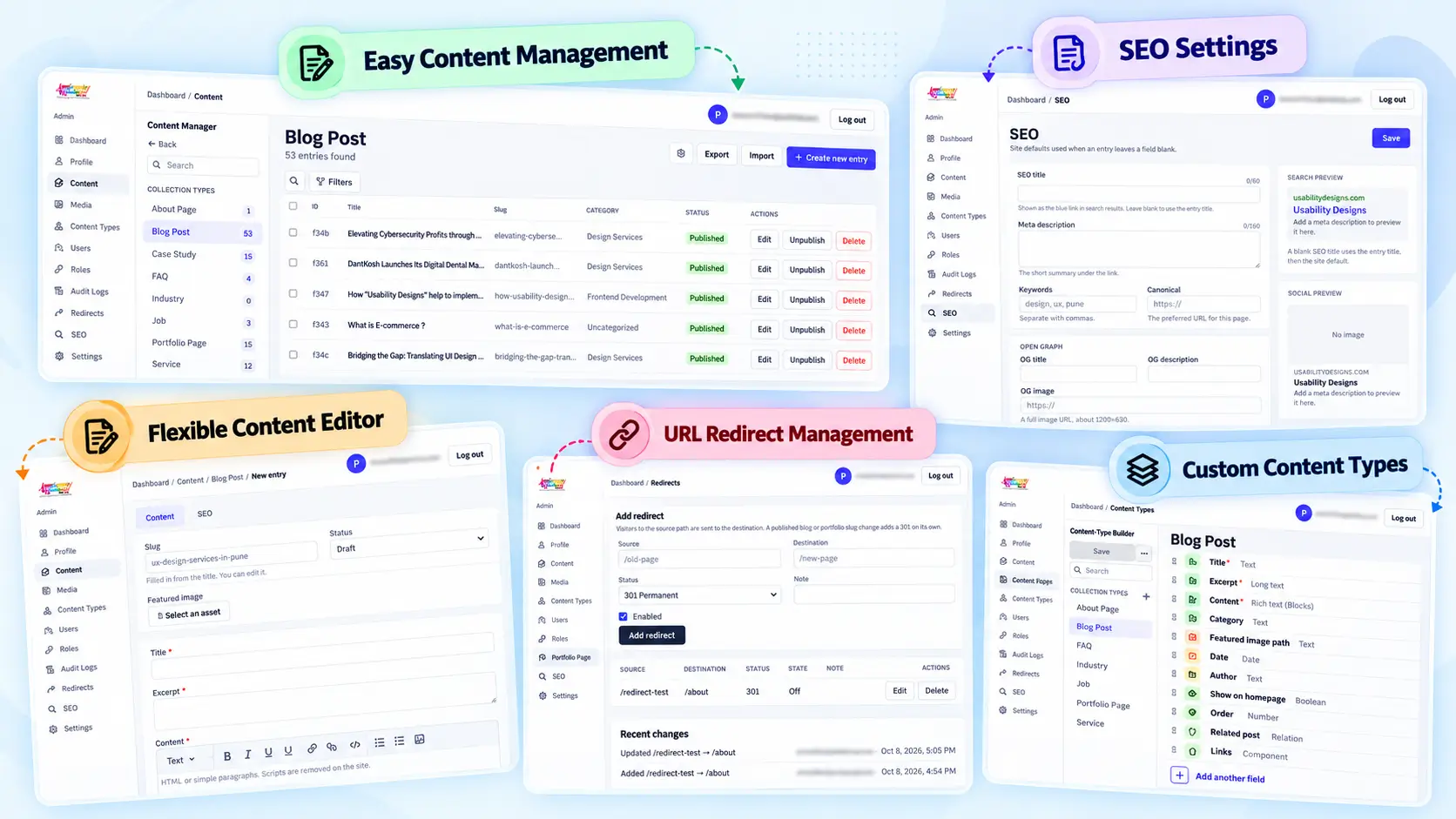
A modern website needs an equally capable content management system. That is why Usability Designs is developing a custom React-based CMS for Next.js websites, giving businesses greater control over content publishing and SEO without depending on expensive third-party headless CMS platforms.
Our CMS is designed to support dynamic content management, configurable content types, and role-based access for administrators, editors, and authors. It also provides essential SEO capabilities, including customizable meta titles and descriptions, SEO-friendly content management, and URL redirection controls.
Unlike complex page builders, our approach focuses on structured content management, keeping the editing experience practical while allowing developers to build flexible Next.js frontends.
With a CMS tailored to your website, you can manage blogs, service pages, case studies, and other dynamic content while maintaining control over your content architecture and SEO strategy.
Build Your Next-Generation Website with Usability Designs
Ready to move beyond traditional website builders?
Contact us to explore a high-performance Next.js website tailored to your business goals.
Leave a Comment