
Introduction
Businesses today increasingly depend on partners to generate sales, expand market reach, deliver services, distribute products, and enter new markets. From distributors and resellers to agencies, franchisees, technology partners, and referral partners, managing a growing partner ecosystem can quickly become complex.
Using spreadsheets, emails, shared documents, and multiple disconnected tools may work when you have a handful of partners. But as your partner network grows, these processes can lead to duplicated information, missed opportunities, inefficient communication, and limited visibility into partner performance.
This is where a Partner Management System can help.
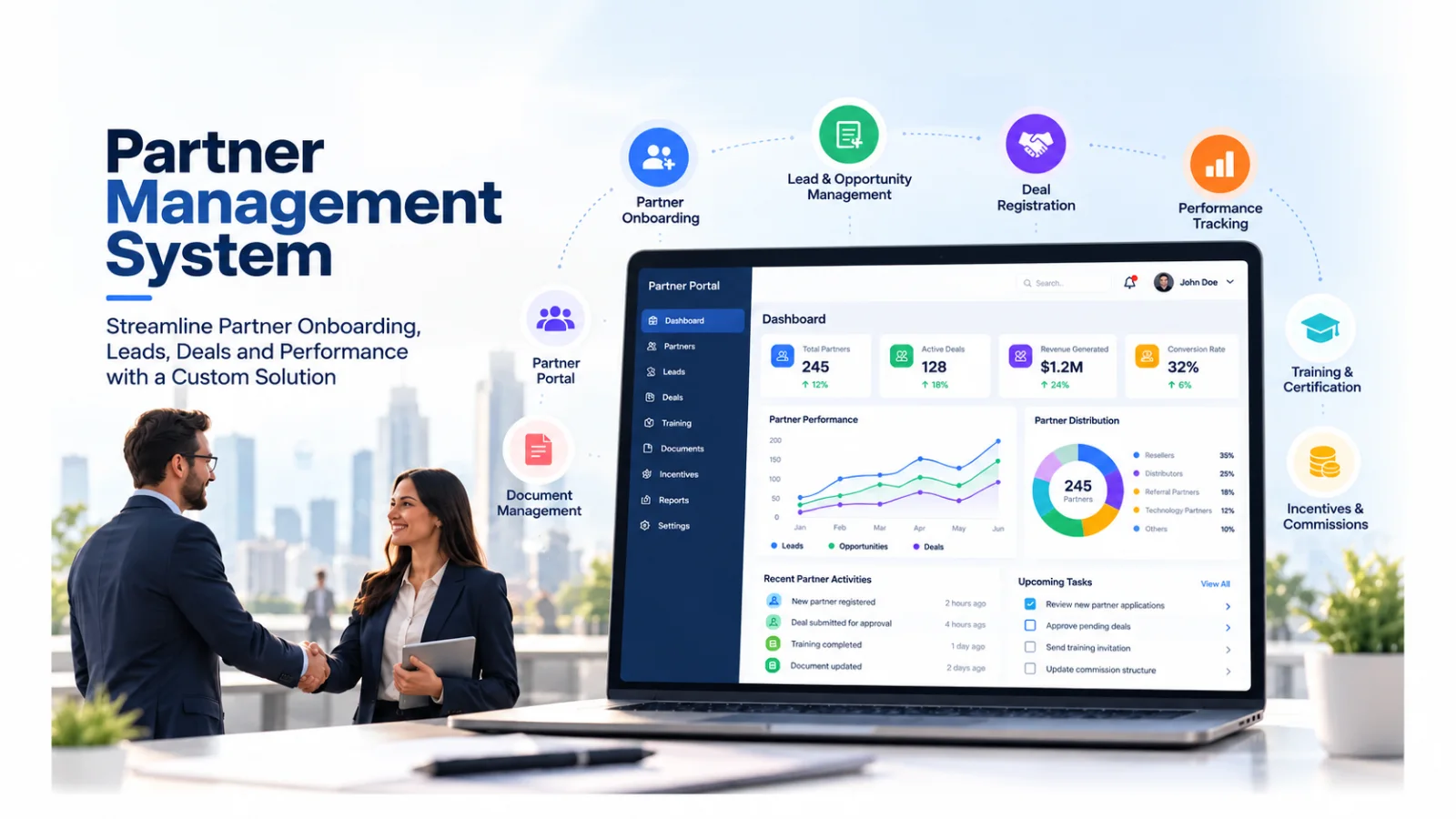
A modern Partner Management System provides a centralized platform to manage partner onboarding, partner information, leads, opportunities, deal registration, communication, documents, incentives, performance, and reporting.
For organizations with unique business processes, custom partner management software can provide greater flexibility, automation, and scalability than a generic off-the-shelf solution.
What Is a Partner Management System?
A Partner Management System is a software platform designed to help businesses manage their relationships and operations with external partners.
Depending on your business model, the system can include partner registration and onboarding, partner profiles and contact management, document management, partner portals, lead submission and management, deal registration, opportunity management, sales pipeline tracking, partner communication, product and service information, training and certification, commission and incentive management, performance tracking, reports and analytics, role-based access, and automated notifications and workflows.
Instead of managing partner activities across spreadsheets, emails, CRM systems, and messaging platforms, businesses can centralize their partner operations in one digital platform.
Why Does Your Business Need a Partner Management System?
Managing partners manually becomes increasingly difficult as your network grows. Your sales team may receive leads through email, partners may submit opportunities through spreadsheets, finance may maintain commission records separately, and management may rely on manually prepared reports.
A Partner Management System brings these processes together.
1. Centralize Partner Data
A centralized partner database can store company information, contacts, agreements, documents, territories, partner types, account managers, status, and other relevant information.
2. Automate Partner Onboarding
Partner onboarding can involve registration, document submission, verification, approval, agreement signing, training, and activation. A custom system can automate this workflow.
3. Manage Partner Leads and Opportunities
Partners can submit leads directly through a partner portal instead of sending them through email. Your sales team can review, assign, approve, reject, and track those opportunities.
4. Manage Deal Registration
A Partner Management System can allow partners to register potential deals and enable your internal team to review and approve them according to predefined business rules.
5. Track Partner Performance
Management can monitor leads generated, opportunities created, deals closed, revenue, conversion rates, partner activity, territory sales, product performance, incentives, training completion, and engagement.
1. Centralize Partner Data
A centralized partner database can store company information, contacts, agreements, documents, territories, partner types, account managers, status, and other relevant information.
Your sales, marketing, finance, operations, and management teams can access the information they need from a common platform.
2. Automate Partner Onboarding
Partner onboarding can involve registration, document submission, verification, approval, agreement signing, training, and activation.
A custom system can automate this workflow.
Example: Registration → Verification → Approval → Agreement → Training → Activation.
Different users can be assigned responsibilities at each stage, while automated notifications keep everyone informed.
3. Manage Partner Leads and Opportunities
Partners can submit leads directly through a partner portal instead of sending them through email.
Your sales team can review, assign, approve, reject, and track those opportunities. This creates better visibility into your partner-generated pipeline and helps establish a structured process for partner sales.
4. Manage Deal Registration
For businesses that work with multiple resellers or channel partners, deal registration can be particularly important.
A Partner Management System can allow partners to register potential deals and enable your internal team to review and approve them according to predefined business rules.
5. Track Partner Performance
Management can monitor partner activity through dashboards and reports. Depending on the business model, metrics can include leads generated, opportunities created, deals closed, revenue generated, conversion rates, partner activity, sales by territory, product performance, incentives and commissions, training completion, and partner engagement.
Which Industries Can Benefit From Partner Management Software?
Partner Management Systems are useful across many industries where organizations depend on external companies or individuals to generate business, distribute products, deliver services, or extend their market presence.
IT & Software Companies
Technology companies often work with resellers, system integrators, implementation partners, consultants, and technology alliances. A Partner Management System can help manage reseller onboarding, software leads, deal registration, partner certifications, product training, sales opportunities, partner incentives, and co-marketing activities.
Manufacturing Companies
Manufacturers frequently depend on distributors, dealers, retailers, and regional sales partners. A custom solution can help manufacturers manage dealer onboarding, distributor management, product catalogs, sales leads, orders and opportunities, territory management, incentive programs, dealer performance, and product availability.
Financial Services & Insurance
Financial organizations may work with agents, brokers, referral partners, and other intermediaries. A Partner Management System can support agent onboarding, document collection, lead management, application tracking, partner performance, commission management, compliance workflows, and communication.
Healthcare & Medical Businesses
Healthcare organizations, medical product manufacturers, laboratories, distributors, and healthcare technology companies may work with distributors, dealers, hospitals, clinics, and referral partners. A partner platform can help manage partner information, product resources, sales opportunities, onboarding, documentation, and communications while allowing organizations to implement access controls appropriate to their business requirements.
Real Estate
Real estate organizations can work with channel partners, brokers, referral agents, property consultants, and agencies. A custom Partner Management System can help manage broker registration, property information, lead distribution, lead tracking, booking status, referral commissions, partner performance, and communication.
Travel & Hospitality
Hotels, travel companies, tour operators, and travel technology businesses often work with travel agents, corporate partners, affiliates, and booking partners. A partner platform can help manage partner onboarding, booking referrals, commissions, offers, promotional materials, and performance.
Education & EdTech
Educational institutions and EdTech companies may work with education consultants, referral partners, training organizations, franchise partners, and channel sales representatives. A Partner Management System can streamline partner registration, student leads, referrals, commissions, marketing resources, and partner performance.
Logistics & Transportation
Logistics companies can use partner management platforms to manage transport partners, delivery partners, freight agents, regional operators, and service providers. Custom workflows can support partner onboarding, document management, assignments, performance tracking, and operational reporting.
Franchise Businesses
Franchise-based businesses have a particularly strong use case for centralized partner or franchise management. A custom system can manage franchise applications, approvals, agreements, location information, training, marketing resources, sales reporting, performance, royalty or incentive information, and communication.
Why Choose Custom Partner Management Software?
There are many ready-made Partner Management and PRM platforms available. These can be suitable when your business processes closely match the functionality offered by the software.
However, businesses often have unique requirements. Your organization may have a specific partner hierarchy, approval process, commission structure, pricing model, territory model, CRM workflow, or ERP integration.
Instead of changing your business process to fit software, custom partner management software allows the software to be designed around your business process.
Custom software is particularly useful when the business has unique partner hierarchies, approval processes, commission structures, pricing models, territory rules, CRM workflows, or ERP integrations.
Custom Partner Portal
You can create a dedicated portal where partners can register their company, manage their profile, submit leads, register deals, track opportunities, access product information, download marketing materials, complete training, submit support requests, view commissions, and track performance.
The portal can also provide different functionality based on partner type and user role.
Custom Workflows
Every organization can have different approval and operational processes. Custom software allows workflows to be designed specifically for your business.
For example: Partner Registration → KYC/Document Verification → Internal Review → Approval → Agreement → Training → Activation.
Additional automated rules can be added according to partner type, geography, product, revenue potential, or other business criteria.
Integration With Existing Business Software
A Partner Management System does not necessarily need to operate as a standalone application. It can be integrated with CRM, ERP, accounting software, marketing automation, email platforms, payment gateways, customer support systems, analytics platforms, inventory systems, internal applications, and third-party APIs.
This can help eliminate duplicate data entry and create a connected business workflow.
Custom Partner Management Software vs. Off-the-Shelf Software
| Requirement | Off-the-Shelf | Custom |
|---|---|---|
| Standard partner management | Suitable | Suitable |
| Unique business workflows | May be limited | Highly flexible |
| Custom partner portal | Depends on platform | Fully customizable |
| Custom integrations | Depends on APIs | Designed around your systems |
| Unique commission rules | May require workarounds | Can be built specifically |
| Custom dashboards | Usually configurable | Fully customizable |
| Business-specific automation | Limited by platform | Highly flexible |
| Scalability | Depends on vendor | Can be designed for your roadmap |
| User experience | Template-based/configurable | Designed around your users |
| Ownership and control | Vendor dependent | Greater control over solution |
How Much Does Custom Partner Management Software Cost?
The cost of developing a Partner Management System depends significantly on its functionality and complexity.
A basic solution containing partner registration, profiles, document management, and a simple dashboard will have different development requirements from an enterprise platform containing partner portals, deal registration, CRM/ERP integrations, commission management, advanced analytics, and automated workflows.
Typical cost factors include number of user roles, partner portal requirements, number of workflows, UI/UX complexity, third-party integrations, CRM/ERP integration, mobile application requirements, reporting and analytics, automation requirements, security requirements, cloud infrastructure, and ongoing maintenance and support.
Instead of choosing software based only on its initial development cost, businesses should also consider long-term operational value, scalability, integration requirements, and potential reduction in manual processes.
When Should You Consider Building a Custom Partner Management System?
Custom development may be worth exploring when your partner network is growing rapidly, your current process relies heavily on spreadsheets, partners submit leads through email or messaging platforms, you need a dedicated partner portal, your approval workflows are complex, you need integration with CRM or ERP systems, your commission or incentive structure is unique, existing PRM software does not match your requirements, you need customized dashboards and reporting, you want complete control over the user experience, or you expect your partner ecosystem to expand significantly.
How Usability Designs Can Help
Usability Designs helps businesses design and develop custom digital platforms based on their specific business requirements.
For a Partner Management System, our team can support the project from business analysis and UX design through software development, integrations, deployment, and ongoing improvements.
Business Process Analysis
We start by understanding how your organization currently manages partners and identifying opportunities to improve and automate the process.
UX/UI Design
Our UX team designs intuitive experiences for both internal teams and external partners, helping simplify complex workflows.
Custom Web Application Development
We can develop a scalable web-based Partner Management System tailored to your business requirements.
Partner Portal Development
We can create dedicated portals that allow partners to manage leads, opportunities, documents, resources, training, and other activities.
API & System Integration
Automation & Workflows
Manual processes can be transformed into automated workflows for approvals, notifications, assignments, reminders, and reporting.
Dashboards & Analytics
Custom dashboards can provide management with visibility into partner activity, sales opportunities, revenue, and performance.
Build a Partner Management Platform Designed Around Your Business
A Partner Management System can become much more than a database of partner information. When properly designed, it can connect partners, sales teams, marketing, operations, finance, and management through a single digital platform.
For organizations with standard requirements, an existing partner management platform may be sufficient. But when your business has unique processes, complex workflows, multiple partner types, or specific integration requirements, a custom Partner Management System can provide greater flexibility and control.
At Usability Designs, we combine UX design, custom software development, modern web technologies, API integration, automation, and business process optimization to build digital solutions around your specific requirements.
Whether you need a partner portal, channel partner management software, dealer management system, reseller management platform, or complete Partner Management System, our team can help you transform your existing partner operations into a scalable digital solution.
Call to Action
Looking to Build a Custom Partner Management System?
Tell us about your partner ecosystem, current challenges, workflows, and business goals. Our team can help you define the right features, user experience, technology architecture, and development roadmap for your solution.
Talk to Usability Designs about building a custom Partner Management System for your business.
Leave a Comment